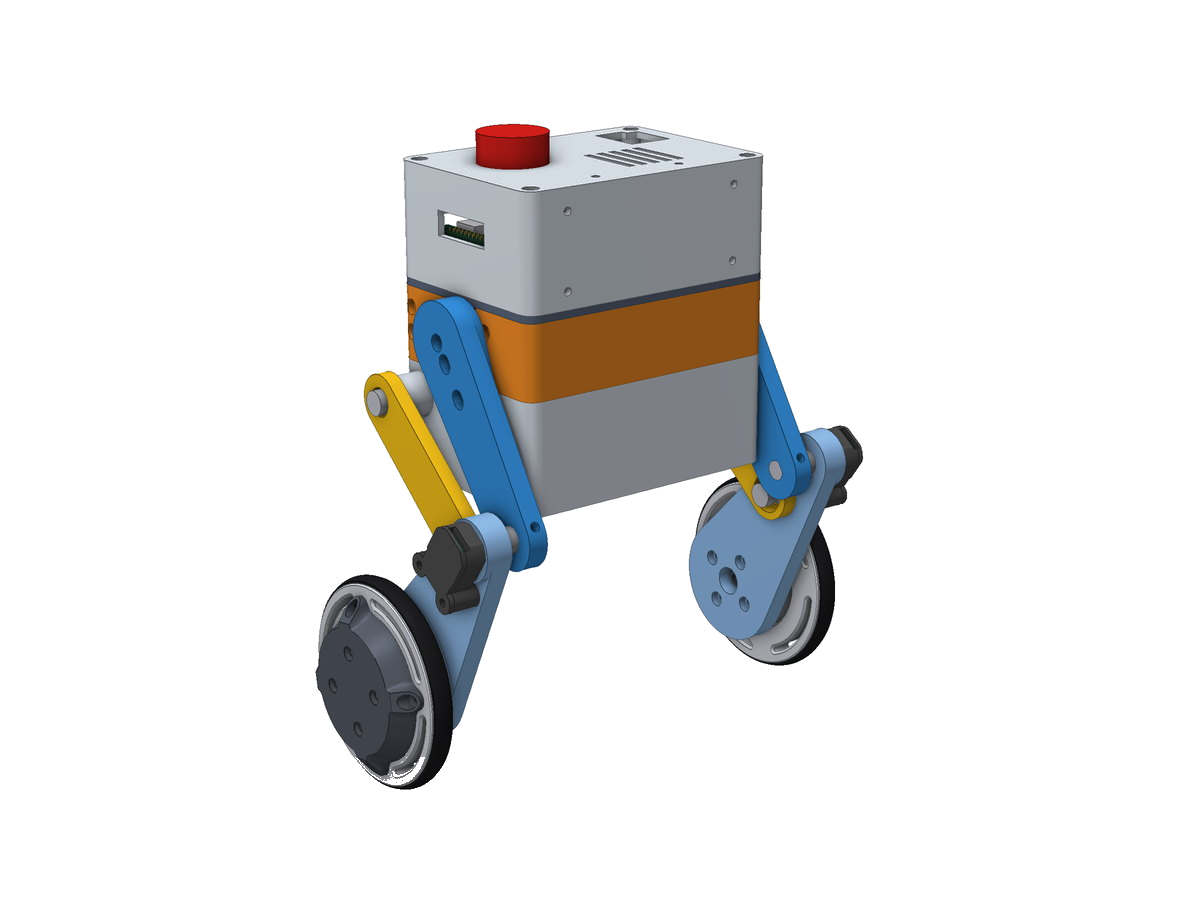
Balance Robot v1.

A wheeled biped, built as one system.

The wheel stays under the hip.

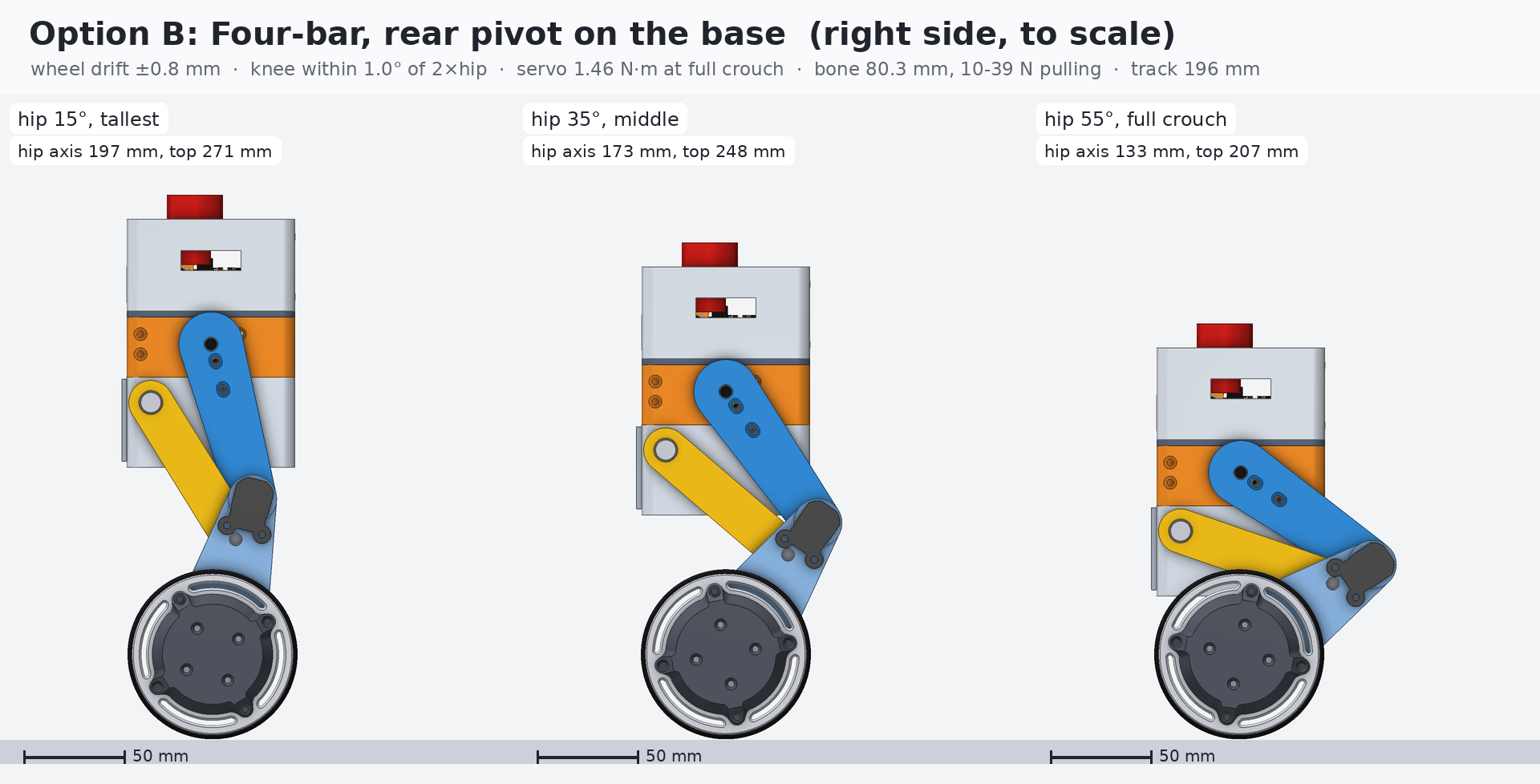
Four-bar legs, hip 15–55°. The wheel stays within 0.8 mm of under the hip.

Direct drive, 10 kHz.

Two GM4108H gimbal motors. No gearbox, so no backlash.

Balance at 400 Hz.

The C906 core runs the LQR. Linux only sends intent.

219 parts. One PCB.

Robotics Board v0.8. The motors stay off until the safety chain is armed.

The platform

One robot, one board, one codebase.

Our first project is a two-wheeled balancing biped with adjustable legs, and the custom Robotics Board that drives it. Both are documented end to end and generated from source.

Balance Robot v1 side view at three leg heights

Balance Robot v1

Prototype build

A wheeled biped with four-bar legs. One hip servo per leg sets the height and the wheel stays under the hip; two direct-drive brushless motors keep it upright.

  • Four-bar leg: wheel within 0.8 mm of under the hip, 15–55° hip range
  • GM4108H gimbal motors with field-oriented control, no gearbox backlash
  • 3D-printed body (PLA/PETG), 4S LiPo, top-mounted E-stop
  • URDF, ROS 2 description and Isaac Lab tasks generated from the CAD
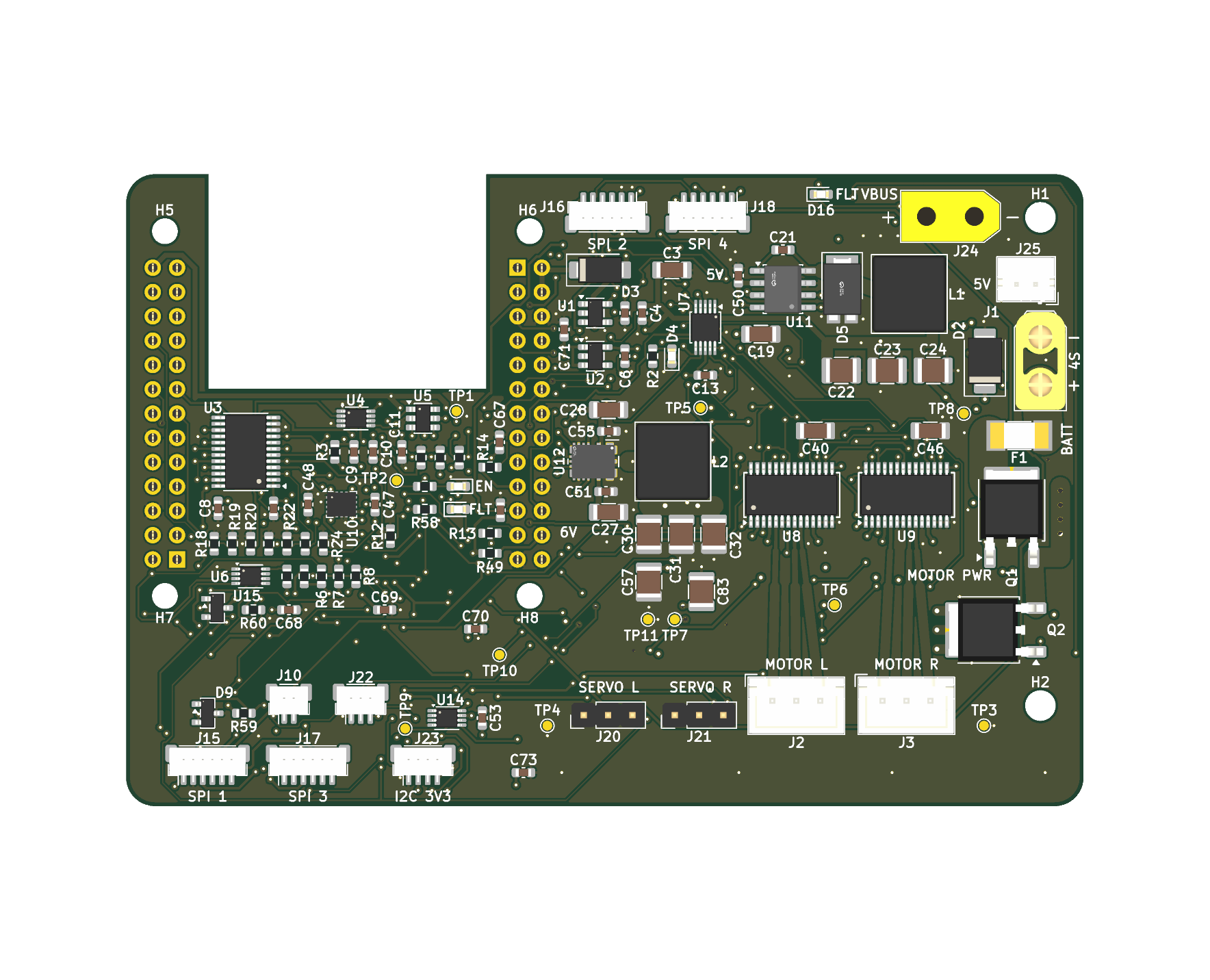
Top view of the Robotics Board v0.8 PCB

Robotics Board v0.8

Design frozen

A carrier board for the Milk-V Duo S that puts motor drivers, power conversion, IMU and the safety chain on one 4-layer PCB. No external microcontroller is needed.

  • 2 × DRV8313 three-phase drivers, 5.3 V / 5 A and 6 V / 8 A bucks
  • BMI323 IMU, ADS1115 rail monitor, four SPI angle-sensor ports
  • Latched hardware E-stop and watchdog: motors stay off until armed
  • Status LEDs and test points on every safety signal
What we focus on

Four engineering principles.

Agile robots fail in the gaps between disciplines. We close those gaps by owning every layer and checking each one automatically.

Hard real-time on open silicon

The SG2000's C906 RISC-V core runs FreeRTOS with FOC at 10 kHz and the balance loop at 400 Hz. Linux and ROS 2 run beside it on the Cortex-A53.

Safety in hardware

Motor enable is MOT_EN_REQ AND a watchdog AND a latched E-stop. The E-stop also switches off the motor supply, and the board powers up safe.

Everything generated, everything checked

The schematic and PCB come from Python, the body from CadQuery, and the URDF and USD from the CAD. ERC, DRC, interference sweeps and closed-loop tests run on every change.

Simulation first

The firmware controller runs in the loop against physics, and Isaac Lab trains policies across thousands of parallel robots, which are compared with the LQR baseline before hardware.

System architecture

Two cores, one board, no external MCU.

Balance never waits on Linux. Linux sends commands and reads state through fixed-size rings in shared memory; the real-time core owns every sensor and actuator.

Cortex-A53 · Linux

ROS 2

/cmd_vel, height and mode in; /odom, state and diagnostics out.

Supervisor

Arming, fault reset and intent sent at 20–50 Hz. Startup is always DISABLED.

Navigation and perception

Nav2 and policies; heavy tools stay on the PC.

C906 RISC-V · FreeRTOS

400 Hz

Balance task

State estimate, gain-scheduled LQR, yaw and height control, watchdog kick.

10 kHz

Fast ISR

SPI angle frames, voltage-mode FOC with SVPWM for both wheels.

async

I²C task

BMI323 bursts and ADS1115 rails, double-buffered.

Robotics Board v0.8

Drive

2 × DRV8313 → GM4108H wheels; 2 × DS3240 hip servos on 6 V / 8 A.

Sensing

4 × AS5048A (rotors and knees), BMI323 IMU, rail monitor.

Safety chain

Latched E-stop cuts VMOT, 10 ms watchdog one-shot, enable gate.

Film

Balance Robot v1 in motion.

Rendered from the production CAD: every part, screw and cable is the one in the assembly model.

Promo film · 56 s · 19.5 MBWatch the step-by-step assembly guide →
Roadmap

Where Project 01 stands.

We publish status as it is. Designs are complete and checked in software; the next milestones are physical.

Done In progress Next

  1. Nov 2026 · done

    Robotics Board v0.5 → v0.8 routed and frozen

    Four revisions: routed 4-layer layout, accessory power outputs, corrected labels, then every part re-sourced for production assembly. Zero DRC errors, zero schematic mismatches.

  2. Nov 2026 · done

    Body v1 with four-bar legs designed and checked

    Parametric CadQuery model, interference-checked across the full leg sweep, with a mounted model of all 134 pieces of hardware.

  3. Nov 2026 · done

    Digital twin and training

    URDF and ROS 2 description from the CAD, an Isaac Sim asset, the firmware LQR in the loop, and Isaac Lab balance and velocity-tracking policies.

  4. Now

    First boards and first print

    The first production boards, then stage-by-stage bring-up: rails, safety chain, sensors, one motor at a time.

  5. Next

    Calibration and first balance

    Measure motor constants, calibrate the knees against their sensors, identify mass properties, and balance on the floor under supervision.

  6. Later

    Autonomy

    The ROS 2 bridge on hardware, odometry and Nav2, then sim-trained policies deployed beside the LQR.

Build it, bring it up, connect it.

Assembly, first power-on and your first SSH session, step by step.